
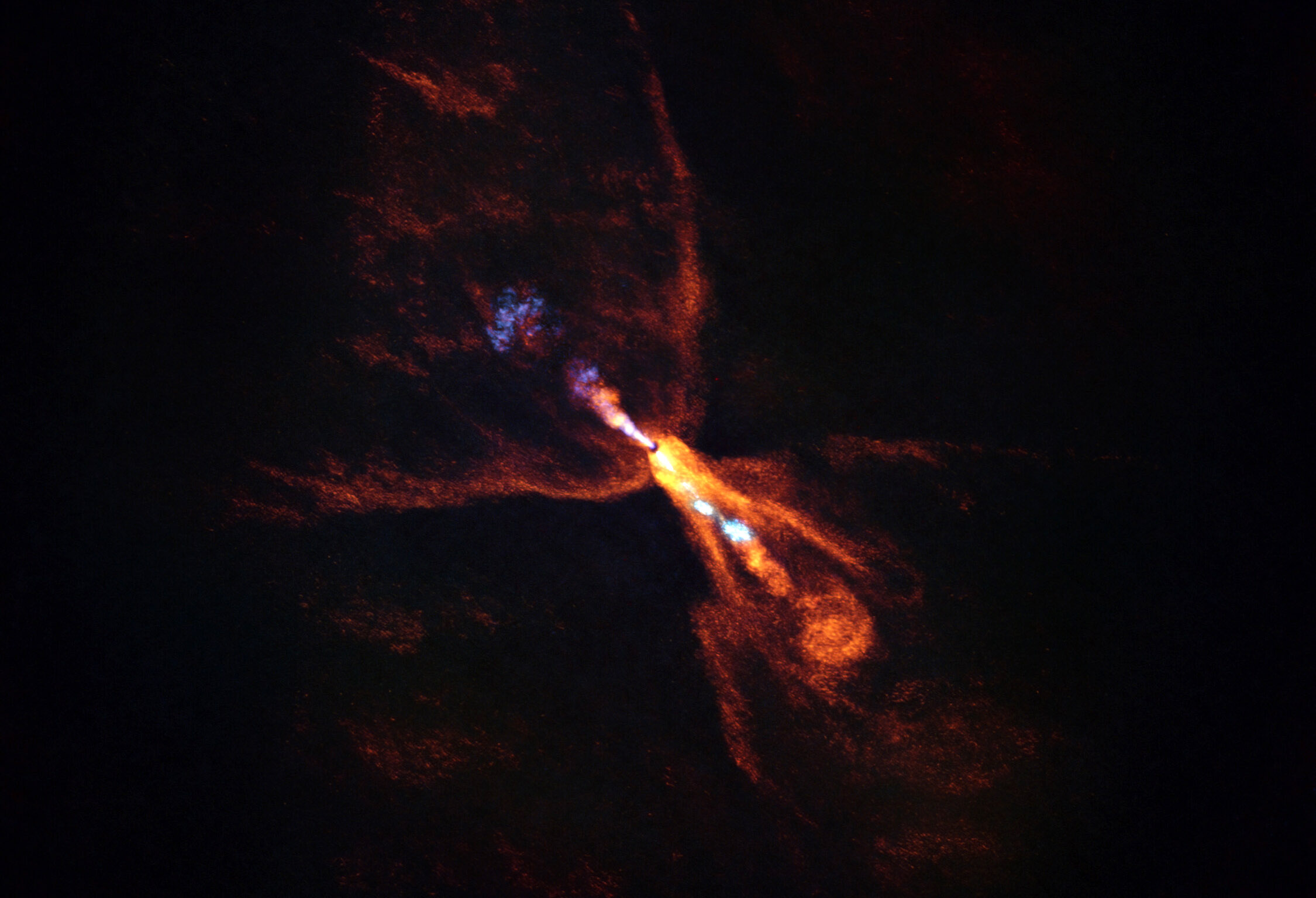
Astronomers have spotted a solar system beyond our own in its very earliest stages of formation. Using both ground- and space-based telescopes, the team zeroed in on the young star, named HOPS-315, at the start of its planet-forming era. The baby star was at just the right orientation for astronomers to get a glimpse of its surrounding disk of gas and dust, which is usually obscured by jets of gas pumped out by newborn stars. Researchers have long sought such a system to help them understand the humble beginnings of our own.
International researchers have, for the first time, pinpointed the moment when planets began to form around a star beyond the Sun. Using the ALMA telescope, in which the European Southern Observatory (ESO) is a partner, and the James Webb Space Telescope, they have observed the creation of the first specks of planet-forming material — hot minerals just beginning to solidify. This finding marks the first time a planetary system has been identified at such an early stage in its formation and opens a window to the past of our own Solar System.

“For the first time, we have identified the earliest moment when planet formation is initiated around a star other than our Sun,” says Melissa McClure, a professor at Leiden University in the Netherlands and lead author of the new study, published in Nature.
Co-author Merel van ‘t Hoff, a professor at Purdue University, USA, compares their findings to “a picture of the baby Solar System“, saying that “we’re seeing a system that looks like what our Solar System looked like when it was just beginning to form.”
This newborn planetary system is emerging around HOPS-315, a ‘proto’ or baby star that sits some 1300 light-years away from us and is an analogue of the nascent Sun. Around such baby stars, astronomers often see discs of gas and dust known as ‘protoplanetary discs’, which are the birthplaces of new planets. While astronomers have previously seen young discs that contain newborn, massive, Jupiter-like planets, McClure says, “we’ve always known that the first solid parts of planets, or ‘planetesimals’, must form further back in time, at earlier stages.”
In our Solar System, the very first solid material to condense near Earth’s present location around the Sun is found trapped within ancient meteorites. Astronomers age-date these primordial rocks to determine when the clock started on our Solar System’s formation. Such meteorites are packed full of crystalline minerals that contain silicon monoxide (SiO) and can condense at the extremely high temperatures present in young planetary discs. Over time, these newly condensed solids bind together, sowing the seeds for planet formation as they gain both size and mass. The first kilometre-sized planetesimals in the Solar System, which grew to become planets such as Earth or Jupiter’s core, formed just after the condensation of these crystalline minerals.

With their new discovery, astronomers have found evidence of these hot minerals beginning to condense in the disc around HOPS-315. Their results show that SiO is present around the baby star in its gaseous state, as well as within these crystalline minerals, suggesting it is only just beginning to solidify. “This process has never been seen before in a protoplanetary disc — or anywhere outside our Solar System,” says co-author Edwin Bergin, a professor at the University of Michigan, USA.
These minerals were first identified using the James Webb Space Telescope, a joint project of the US, European and Canadian space agencies. To find out where exactly the signals were coming from, the team observed the system with ALMA, the Atacama Large Millimeter/submillimeter Array, which is operated by ESO together with international partners in Chile’s Atacama Desert.
With these data, the team determined that the chemical signals were coming from a small region of the disc around the star equivalent to the orbit of the asteroid belt around the Sun. “We’re really seeing these minerals at the same location in this extrasolar system as where we see them in asteroids in the Solar System,“ says co-author Logan Francis, a postdoctoral researcher at Leiden University.
Because of this, the disc of HOPS-315 provides a wonderful analogue for studying our own cosmic history. As van ‘t Hoff says, “this system is one of the best that we know to actually probe some of the processes that happened in our Solar System.” It also provides astronomers with a new opportunity to study early planet formation, by standing in as a substitute for newborn solar systems across the galaxy.
ESO astronomer and European ALMA Programme Manager Elizabeth Humphreys, who did not take part in the study, says: “I was really impressed by this study, which reveals a very early stage of planet formation. It suggests that HOPS-315 can be used to understand how our own Solar System formed. This result highlights the combined strength of JWST and ALMA for exploring protoplanetary discs.” (ESO)


You must be logged in to post a comment.