
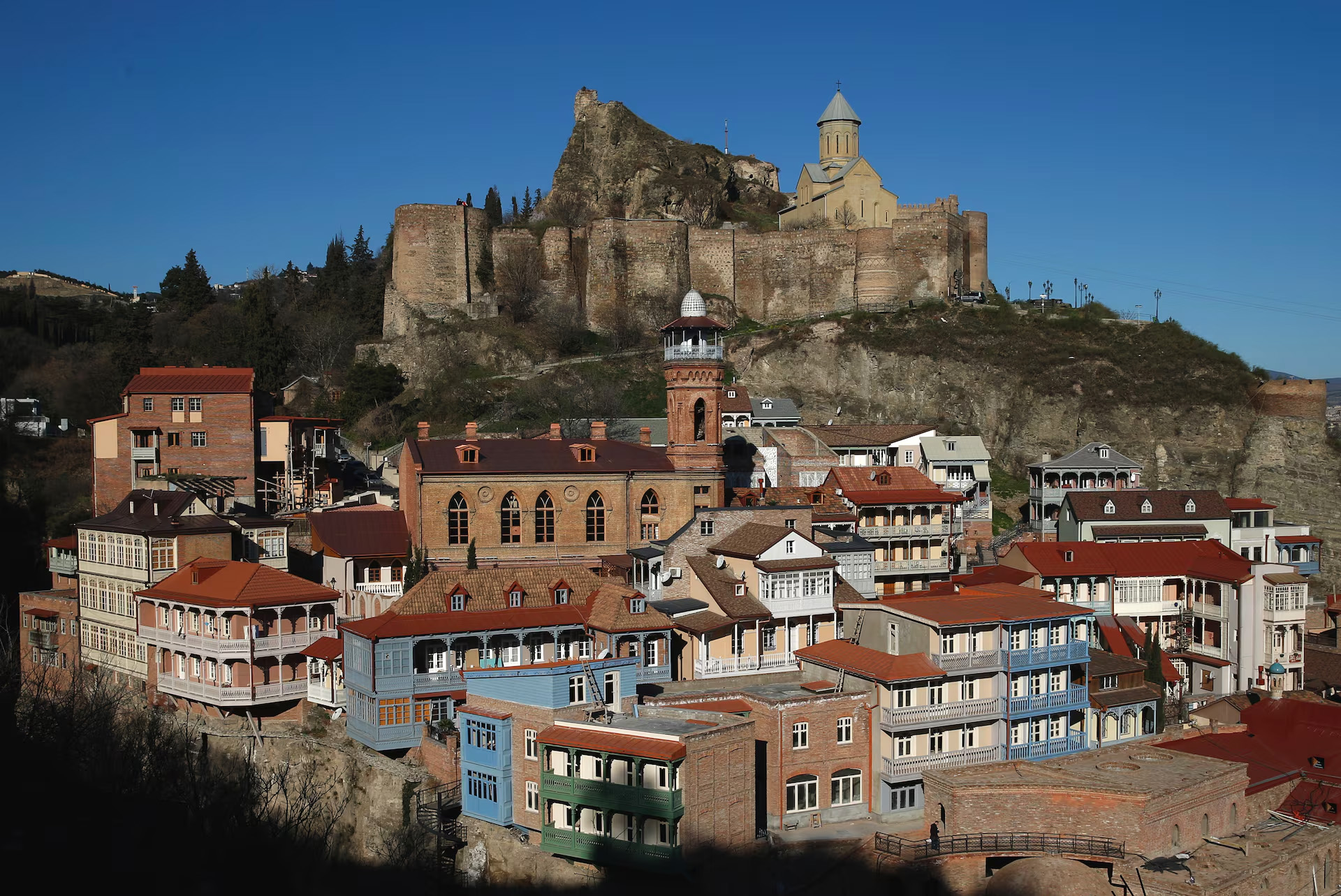
Despite too many impacts still somehow manages to be uniquely Georgian
There can’t be many more visually striking cities in the world than Tbilisi. Splayed out along a narrow river valley, winding its way along cliffs and rock faces, this charming, roguishly dilapidated city borrows something from Greece, Russia, and the Middle East, and yet still somehow manages to be uniquely Georgian.
Tbilisi’s name — which means “a warm place” in Georgian — refers to the hot, sulphureous waters that pour from its soil and fuel its historic bathhouses. But it could just as well refer to its sultry, Mediterranean climate or the welcome meted out by locals, for whom an effusive hospitality is deeply ingrained into the cultural code.

I ended up here quite by accident. After years in Moscow, and amid the chaos of Russia’s 2022 invasion of Ukraine, I became part of a sudden wave of migration as tens of thousands of Russians, Ukrainians, and others sought a safe haven in Georgia, where I now cover the country and its neighbours for Reuters. That I and many of my fellow newcomers remain here three years on — despite political turmoil, street protests and regular power outages — speaks to the richness and beauty of everyday life in Georgia’s picturesque capital.
Here’s my guide on how to explore Tbilisi like a local:
The way around: If you had to build a city of over a million people from scratch, you wouldn’t put it here. Squeezed between two ridgelines, Tbilisi must be one of the oddest shaped cities in Europe. A slender city centre backs onto a looming cliff face and then gives way to suburbs sprawling out to the north and south. But if you can brave the slopes — surely some of the most punishing in any European capital — you’ll be rewarded with stunning views, away from the heaving tourist centre.

The still largely ungentrified hillside neighbourhood of Mtatsminda, which translates to “the holy mountain,” is peppered with secret view points, peering out at the city below, often between ramshackle houses. If you can’t face the slog, a ride up the Tbilisi funicular railway — first installed in 1905 — for an almost birds’ eye view of the city from the clifftop may be in order.
The buildings: Shabby chic Tbilisi breathes history from every stone. From the decaying (yet still, somehow, lived in) Tsarist Russian mansions of the old town and the grandiose Soviet-era piles, to the plate-glass giants favoured by the latest generation of wealthy Georgians, the city can sometimes resemble a living museum. Although parts of Tbilisi have had a tourism-induced glow-up (with mixed results) in the last decade or so, an afternoon wander through the old town’s backstreets is a nice reminder of the slow-paced life that continues here for many locals.

The food: Georgian food, long raved about in the former Soviet Union, has been enjoying newfound fame in Western countries. For me, the standout dish is the khinkali: a juicy, broth-filled boiled dumpling made from dough pleated into a handle used to eat it with your bare hands (only foreigners and children use cutlery!). Native to mountain villages a few hours from Tbilisi, khinkali were originally made from beef only, but new flavours have since appeared to meet changing tastes. Vegetarians can feast on cheese or mushroom-filled khinkali, while nowadays most common are kalakuri, or “city khinkali”, stuffed with pork and greens. Head to Klike’s Khinkali or Zodiaqo for Tbilisi’s best. Pro-tip: The doughy handles should not be consumed, but instead left on your plate as evidence of how many you’ve eaten.

The wine: Georgia, where archaeologists have found evidence of winemaking 8,000 years ago, produces all kinds of wine. But it’s most famous for its orange, or amber varieties — dry, earthy wines made with high levels of grape skin contact and aged for months in earthenware vessels, known as “qvevris.” Try a rkatsiteli, a tsolikauri, or a krakhuna as an intro.
Tbilisi, conveniently located only abouta 1.5-hour drive from the country’s main wine producing region, Kakheti, is swimming in the stuff. For a European-style wine bar experience, try DADI, or 8000 Vintages, both in the city centre. For something more adventurous, most of the small family-owned grocery shops that pepper the city sell their own homemade wine in plastic bottles, and will be delighted for visitors to try it.

Getting away: During the Tbilisi summers, which can reach 40 degrees Celsius (104 degrees Fahrenheit) and are coupled with a brutal humidity, many locals head out of the city for cooler pastures. One option is the hilltop resort town of Kojori, a half-hour drive from the city, where communist-era dignitaries had their holiday homes. Another is the so-called Tbilisi Sea — in reality a massive reservoir a few miles from the city. On a hot summer’s day, you can join the Tbilisi families who pour out of the city for the shoreline for a sense of how ordinary Georgians spend their days off.
CITY MEMO DATA POINTS
Population: 1.3 million
Price of a khinkali: 2 lari ($0.74) at Zodiaqo, just off the central Rustaveli Avenue. For my money, it’s Tbilisi’s best. The khinkali here have ultra-thin dough, and a certain zestiness I suspect comes from a dash of lime juice. Minimum order is five.
Price of a glass of Georgian amber wine: 14 lari ($5) at DADI bar, behind Freedom Square.
Price of 15 eggs: 8.95 lari ($3.32) at Carrefour.

Great place to see a sunset: Turtle Lake, high up in the hills above the tony suburb of Vake.
Essential read: “The Eighth Life,” by Nino Haratischvili is an epic, 934-page novel about multiple generations of one Georgian family amid the rise and fall of the Soviet Union, set mostly in old time Tbilisi.


You must be logged in to post a comment.