
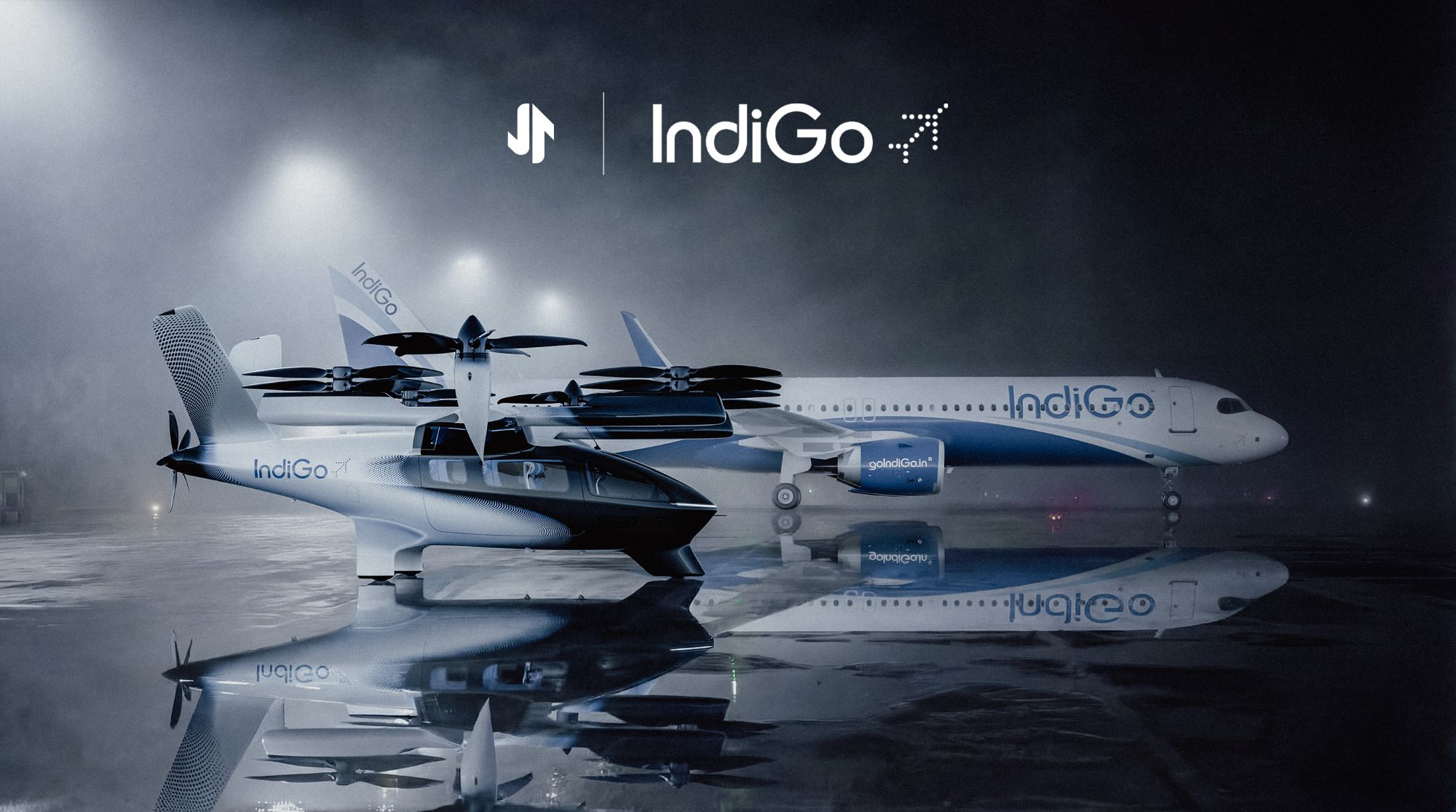
Makes a strategic equity investment — the first step toward first nationwide air taxi network
India built the world’s largest railway network. It is building the world’s most ambitious highway expansion. It built one of the world’s fastest-growing airline industries pioneered by IndiGo. And yet — every day, in every major city, millions of Indians lose millions of hours to a mobility problem that none of these systems were designed to solve.
The problem is the middle distance. Too far to drive efficiently. Too short to fly conventionally. Too urgent to wait.
Sarla Aviation and IndiGo have announced that IndiGo Ventures has made a ₹10 crore strategic equity investment in Sarla Aviation — the first step toward building India’s first nationwide air taxi network, designed for the 0–300 km corridors that define daily life in the world’s most populous nation. This investment comes as a late announcement and was part of Sarla Aviation’s last funding round, led by Accel and Nikhil Kamath.
The Middle-Distance Trap
India’s mobility infrastructure was designed for two extremes: local (roads, metro, auto-rickshaws) and long-distance (railways, airlines). But the space in between — the 30 km airport transfer, the 100 km inter-city commute, the 200 km emergency medical run — falls into a gap where nothing works well.
Electric vertical flight changes that. Quiet, low-emission, runway-independent aircraft that operate at a fraction of helicopter cost can turn the middle distance from India’s biggest mobility failure into its greatest opportunity
Why This Investment, Why Now
The eVTOL industry has matured rapidly. Batteries have improved. Hybrid-electric architectures have proven reliable. Regulators globally — including DGCA — are building certification pathways. The question is no longer “can this work?” but “who will build the system?”
Sarla Aviation answers the hardware question. With India’s largest private eVTOL demonstrator, a hybrid-electric platform designed for Indian conditions, and a team with deep experience from Lilium, Beta, Volocopter and Joby, Sarla has demonstrated execution speed and engineering maturity that position it as the country’s leading eVTOL OEM.
IndiGo answers the system question. As India’s largest airline, with 2,000+ daily flights, 85+ airports, world-class MRO, and decades of safety culture, IndiGo provides the operational backbone, distribution network, and institutional credibility that no startup can replicate alone.
This ₹10 crore commitment from IndiGo Ventures is more than capital — it is a strategic signal. It unites India’s leading eVTOL OEM with its largest airline into what the country has never had: an aligned OEM-operator ecosystem building toward certified, commercial air-taxi operations at national scale.
Commenting on the investment, Adrian Schmidt, Co-Founder & CEO, Sarla Aviation, said: “IndiGo’s investment marks a turning point — not just for Sarla, but for the future of how India moves. For decades, Indians have accepted that distance means delay, that geography is a constraint you live with. We believe that era is ending. Having IndiGo — the airline that made flying accessible to hundreds of millions of Indians — stand behind this vision gives it a weight and credibility that we could not have built alone. India has always dreamed big. Now we have the partners to match the dream.”
A Global Race, an Indian Advantage
Across the world, the airline-OEM investment model is the proven path to commercialisation. United Airlines has invested in Archer Aviation. Delta Air Lines has backed Joby Aviation. American Airlines has partnered with Vertical Aerospace.
But India holds a structural advantage that no Western market can match: unparalleled demand density. The congestion, the population, the geographic spread, the medical logistics gap, the tourism corridors, the defence requirements — India doesn’t just need air mobility. India is where air mobility makes the most sense on Earth.
A Sarla-IndiGo investment doesn’t follow the global playbook. It writes India’s own — at a scale the rest of the world will study.
The Ripple Effect
Beyond mobility, this investment catalyses a broader industrial transformation:
- Thousands of high-skill aerospace jobs across manufacturing, engineering, operations, and maintenance
- A domestic supply chain for composites, avionics, batteries, and embedded systems
- Strengthened DGCA capability for next-generation aircraft certification
- Faster emergency medical transport saving lives in underserved regions
- New economic corridors connecting Tier-2 and Tier-3 cities to major hubs
- Defence logistics modernisation through dual-use aerial platforms
India has built world-class systems before — in IT, in space, in digital payments. Air mobility is the next frontier. And for the first time, the OEM and the operator are Indian, aligned, and ready.
Roads couldn’t connect India’s villages. Railways struggle to connect its cities. Cars in cities are stuck. Air taxis will connect all of the above — in real time.
Potential Early Corridors
Below are indicative routes that reflect the types of missions a Sarla-IndiGo air taxi network could serve. These are not confirmed routes and may evolve as the investment progresses.
Bengaluru Airport → Electronic City
Today: 92 min. | Tomorrow: 10
Juhu → Pune
Today: 219 min. | Tomorrow: 30
Gurugram → Noida
Today: 121 min. | Tomorrow: 15
Mopa Airport → South Goa
Today: 144 min. | Tomorrow: 21
Kochi → Munnar
Today: 196 min. | Tomorrow: 10


