
From Spawning Salmon to Rare Bats: Why Nature Lovers are Heading to Vilnius
As nature-based tourism continues to grow globally – driven by travelers prioritizing sustainability, conservation, and authentic outdoor experiences – experts reveal how Vilnius, with its internationally recognized green spaces, walkability, and peaceful atmosphere, is perfectly positioned for this rising trend
The growing popularity of nature-based tourism is reshaping how people choose their travel destinations. Recent research suggests that travelers are increasingly drawn to destinations where nature is part of everyday urban life, rather than something separate from it.
With Earth Day approaching on April 22, it’s a good time for nature-loving travelers to add Vilnius to their plans. The city shares some special characteristics for urban nature-seeking travelers:
- Vilnius is home to 81 recorded bird species, a number that stands out among European capitals.
- Every year, salmon travel up to 500 km from the Baltic Sea to spawn in the Vilnelė River, right in the city center.
- The city’s bunkers and tunnels host some of the largest hibernating bat populations ir Europe, including the rare European barbastelle.

According to Anton Nikitin, Chief Sustainability Officer at the City of Vilnius, Vilnius has a network of natural and semi-natural areas where different elements of nature come together, creating a sense of being far beyond the city limits. The city shares some special characteristics for urban nature-seeking travelers.
Birdwatching is booming
The global birdwatching tourism market was valued at USD 70.04 billion in 2025 and is projected to reach USD 117.16 billion by 2030 (Grand View Research). GetYourGuide’s 2026 trends report confirms that travelers’ attitudes are shifting: 54% are interested in trying birdwatching on a trip, and 45% now consider it “cool again”.In Vilnius, visitors can experience a surprisingly rich birdwatching environment for a European capital: 81 recorded bird species within city limits, including EU-protected species such as the red-breasted flycatcher, corncrake, and marsh harrier – many living in the city’s mature urban forests.
The highest recorded diversity – 48 bird species – was found on the edge of the city, in the Pilaitė district, where areas of wild nature, including shrublands and open meadows, located next to the residential areas, support diverse bird habitats. “Birds are not only an important part of the urban ecosystem but also one of its key indicators of environmental health, as their populations respond quickly to environmental change,” says Anton Nikitin.


Clean rivers
Only 37% of Europe’s surface waters are in a healthy ecological state, making the Vilnelė River flowing through Vilnius a rare exception.
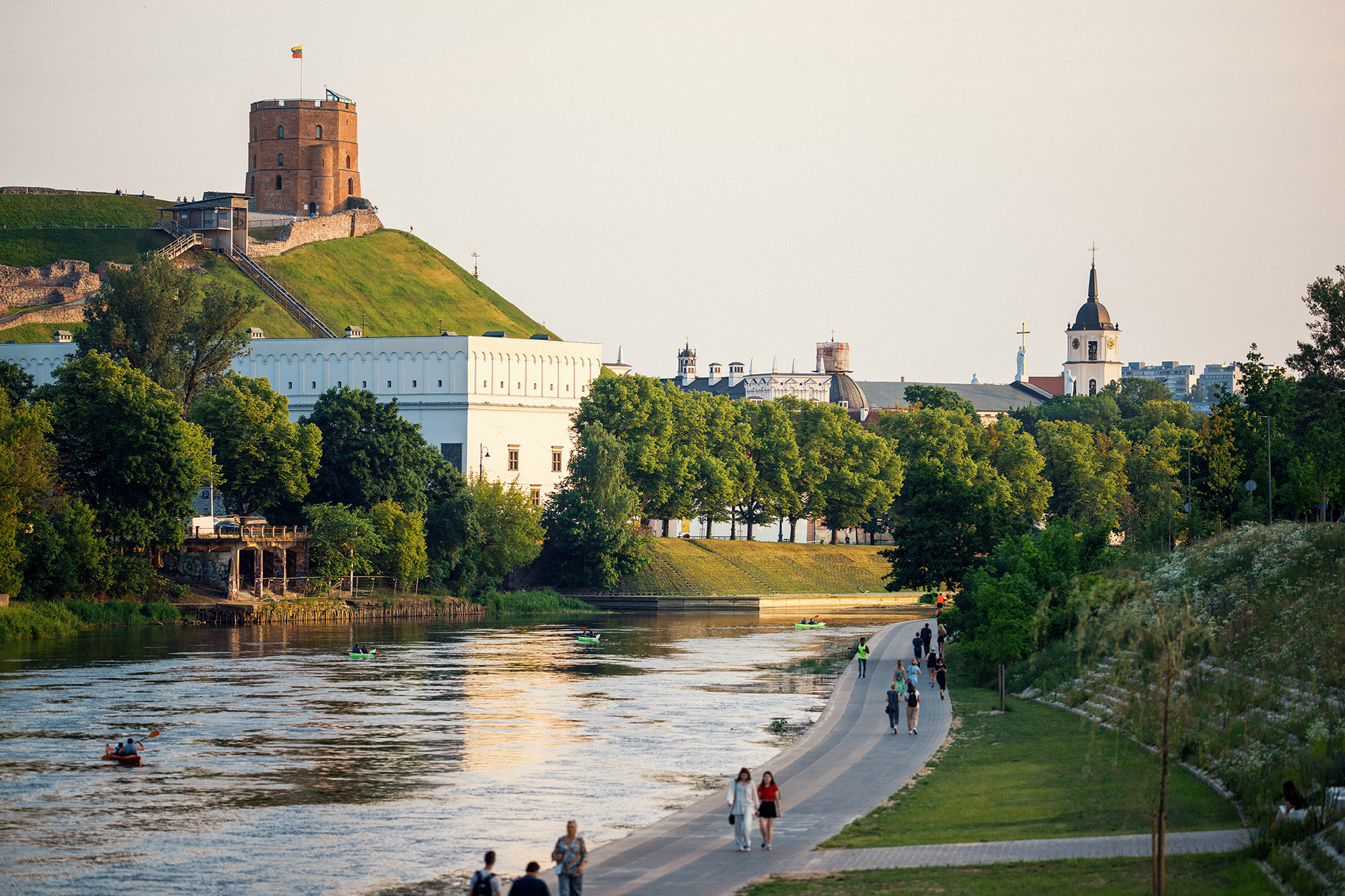
The Vilnelė River has water quality comparable to mountain streams, according to Jolanta Radžiūnienė, biodiversity expert and director of the Pavilniai and Verkiai Regional Parks. This creates rare conditions that support sensitive species such as trout, grayling, and salmon. Every autumn, these salmon travel hundreds of kilometres from the Baltic Sea, often returning to the very same stream where they were born to spawn.
“Salmon can spawn here because the Vilnelė is very rocky, and as water flows over stones, it becomes highly aerated and oxygen-rich. Unlike in the Neris or other streams, where salmon only migrate through, they build nests and reproduce here,” says Jolanta Radžiūnienė.
In a short video, photographer Gabriel Khiterer captured this spectacular salmon journey right in the city center.


The green city travelers are looking for
As travelers increasingly seek destinations that blend city culture with access to real nature, in Vilnius they can find something distinctive:35% of the city is covered by forests, and it’s one of the greenest capitals in the region. Forests in Vilnius are not just places for walks – they are vital infrastructure that protects the city: from air pollution to soil erosion. At the same time, they are homes for life, where animals live right alongside people.
The city has 13 protected nature reserves, and up to 60% of its forested areas are used for parks, recreational spaces, or trails. Biodiversity remains rich even in these spaces: a good example is Vingis Park, which is one of the city’s key recreational and cultural areas.
“Vingis Park is quite heavily influenced by human activity, but the diversity of birds there is probably one of the highest in the city,” says nature photographer Marius Čepulis.
Vilnius is also characterized by its surrounding ancient forests (sengirės), which are among the most valuable biodiversity reservoirs, increasingly rare in managed forests.
Rare wildlife in the city
Wildlife tourism is one of the fastest-growing segments of nature-based travel, with up to 40% of all international tourists interested in wildlife watching (CBI). Few European capitals can offer this within city limits, and Vilnius is one of them.
“Antakalnis bunker and Paneriai tunnel are important wintering sites that host some of the largest hibernating bat populations in Europe. The European barbastelle, one of the rarest bat species in the EU, has also been recorded at these sites, as has Brandt’s bat,” comments Jolanta Radžiūnienė.


During the summer, most bats spend their days in Verkiai Park, while at night they feed along the Neris River and other water bodies.
“Vilnius is home to a surprising variety of species – you can even find grass snakes in residential areas like Žverynas. Many species that were considered rare are now regularly found in the city,” says Marius Čepulis.
As biodiversity across Europe continues to decline, scientists emphasize the importance of protecting nature in urban areas. Vilnius is among the cities where travelers can witness this approach and experience firsthand how a thriving ecosystem and a modern urban environment can coexist side by side.
The Pavilniai and Verkiai Regional Parks organize guided walks and activities that introduce protected areas and the species found there. Seasonal birdwatching tours are also held across the city, including in Vingis Park, where guided walks have been led together with ornithologist Marius Karlonas.


You must be logged in to post a comment.