
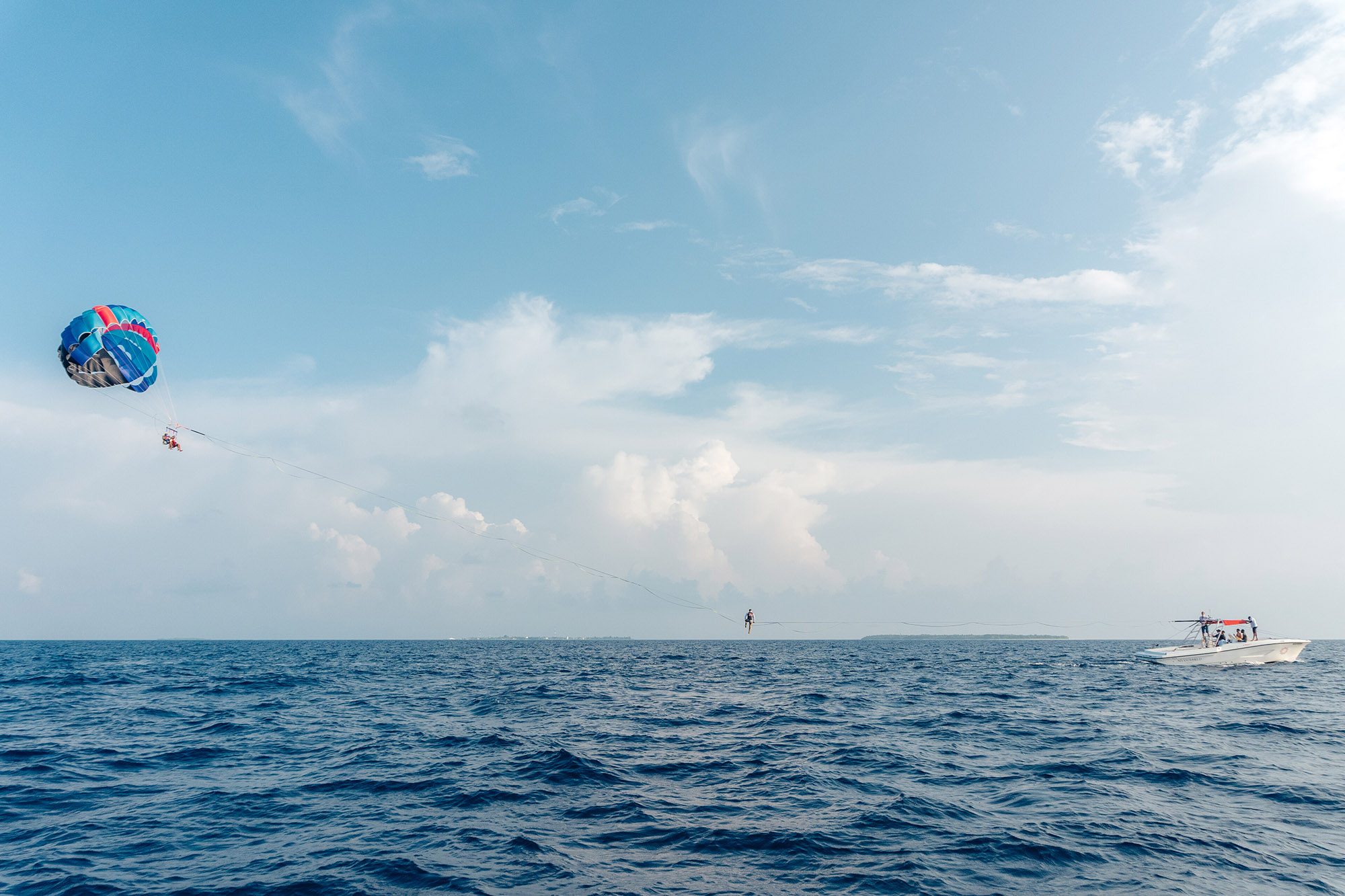
Jaan Roose completes world’s first parasail-to-boat slackline walk in Maldives
The Estonian athlete defied wind, waves, and gravity to balance between two moving anchor points in his most ambitious feat to date.
Estonian three-time world champion Jaan Roose has taken slacklining to uncharted territory, walking a line suspended between a flying parasail and a speeding boat in the Maldives.
The world-first attempt involved two constantly shifting anchor points, and tested the limits of balance, coordination and rigging under unstable conditions. Described as his most technically complex and physically demanding feat yet, the project marks a new chapter in the evolution of the sport.

Snapshot
- A new slackline first: Roose completed the world’s first walk between a parasail and a boat, both unstable and moving in different directions.
- Technical innovation: His team built a bespoke bungee rigging system and introduced custom control toggles to manage the parasail’s movement.
- World’s hardest line: Roose described the challenge as the most demanding of his career, with unstable elevation and unpredictable forces that required him to adapt his posture and walking pace to stay balanced between air and sea.
- Sport-defining feat: The project sets a new benchmark in highline performance, rigging innovation, and physical adaptation.

Deep Dive
Jaan Roose, a three-time world champion in slacklining, has previously completed high-profile walks including a 3.6 kilometre crossing of Italy’s Strait of Messina and an intercontinental walk over the Bosphorus Strait in Türkiye, redefining what’s possible in the sport.
His latest challenge involved walking on a slackline strung between a flying parasail and a moving motorboat towing the vessel in the Maldives. Both anchor points were in motion throughout, affected by wind, current and wave action.
“It was a very unknown world,” Roose admitted. “Would it be possible to walk a parasail slackline? How? And how much?”
To find out, Roose and his team spent a week at Siyam World in the Noonu Atoll, developing and testing equipment to stabilise the line and allow a safe attempt.

The athlete said: “Setting up a slackline between unusual vehicles – one in the air and the second on the water – makes this my most unique project in terms of rigging, because the angle points are totally different.” He continued: “Usually, slackline projects are between two static points. Here we have two objects moving in every direction at the same time.”
A bungee-based system was eventually engineered to reduce the instability of the boat, while modifications to the parasail included toggles that allowed the pilot to influence its motion – a crucial improvement in what is normally an uncontrollable flying canopy.
Meanwhile, the boat’s captain also had to adjust standard parasailing procedures to account for the added pressure of towing a slackline with a person balancing on it.


Despite 15 years of elite slacklining experience, Roose had to adapt his entire movement pattern as a result. Finding a still enough moment to even mount the line was a challenge, while walking it required an entirely new rhythm.
“A big part of this project was definitely the physical challenge, because it’s hard to get on the line and to find a moment to start walking,” he said. “And when I was walking, to adapt my body, my knees. I had to follow the behaviour of the boat and feel what was happening behind my back with the parasail.”
Roose also altered his pacing to manage the changing elevation of the line: “That was the most important part. I had to take two steps at a time instead of focusing on each step individually, because the elevation was constantly changing.”


As the team gained more control over the system, the walk became more achievable. Roose shared: “It was a very intense, long journey – incredibly challenging and successful. Each day, we were getting better and better until we could just play together like an orchestra.”
But even with all the improvements, the most difficult part came right at the end: “Getting close to the finish mark is intense and it doesn’t get easier, because the body is cramped,” he explained. “In this case, as I got really close to the boat, with all its wobble and movement, the slackline system actually didn’t work as well, so I had to pay even more attention to making those last few steps.”
Roose completed the walk with a steady landing on the boat, proving that having a slackline attached to moving objects can be done – and that it’s possible to maintain balance while walking on it.
He said: “We showed that the body actually can balance in such a challenging environment: the world’s hardest slackline.” (Red Bull Content Pool)


You must be logged in to post a comment.