
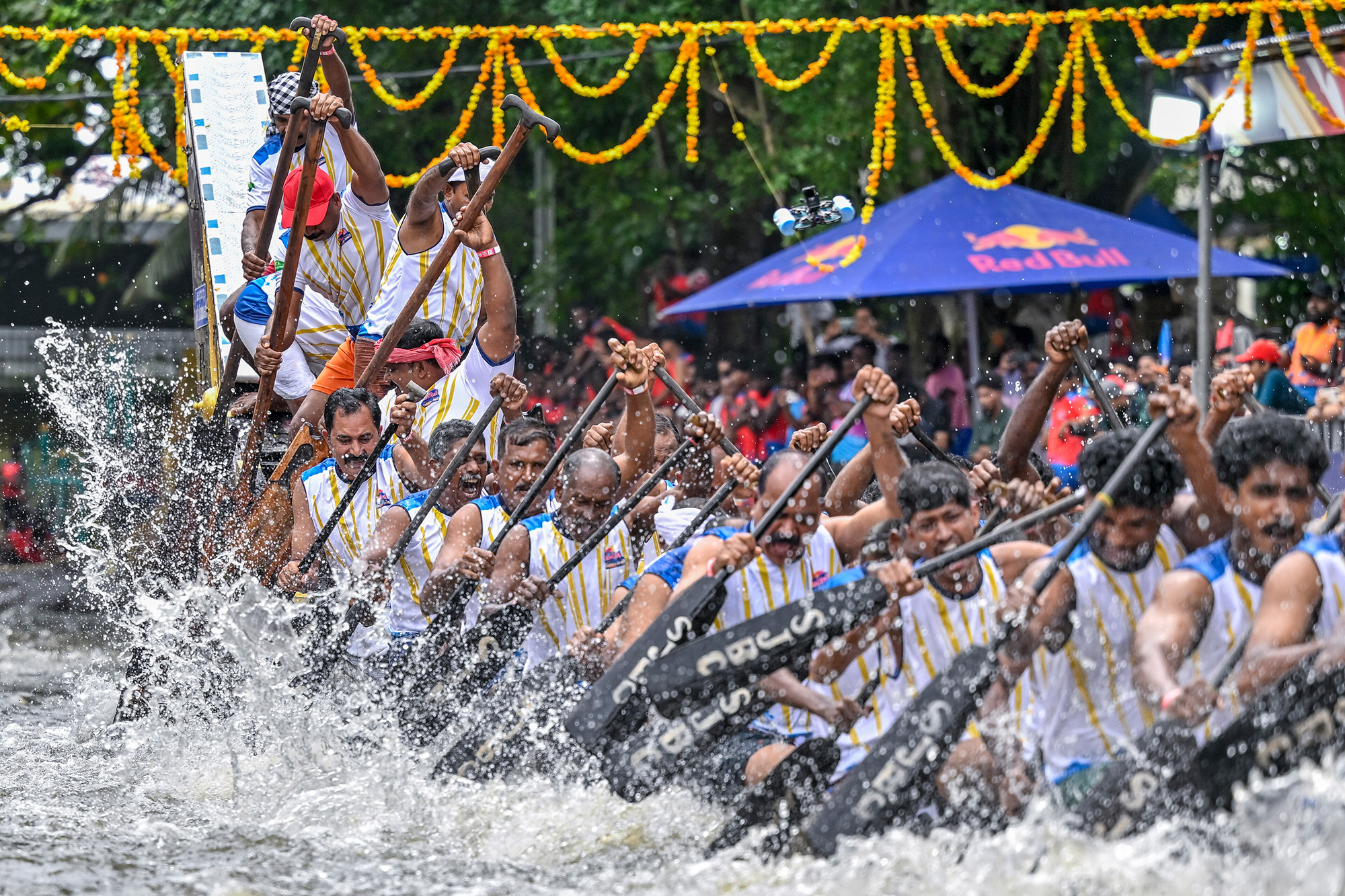
Centuries-old warboats are reimagined in a dramatic contest that blends heritage, ritual and spectacle
On a humid August afternoon, the usually placid waters of Kerala’s backwaters rippled with uncommon intensity. Along the Muppalam Canal in Alappuzha – an emerald waterway familiar from Indian cinema – thousands gathered to watch oars slash water in unison, drums reverberate against the banks, and rowers turn centuries of heritage into living theatre.
The occasion was Red Bull Vallam Vali, a contemporary interpretation of Kerala’s famed boat races. The event brought together two beloved traditions: Vallam Kali (literally “boat game”), the centuries-old regattas that have long animated these waterways, and Vadam Vali, the tug of war – here reimagined as a ‘Tug of Oars’.

By day’s end, the Ashtamadi Acers had emerged triumphant, winning both the Chundan and Churulan boat categories. Yet for many watching from the shore, the contest was less about victors and more about witnessing heritage take on a striking new form.
Snapshot
- The Boats: Kerala’s racing craft range from the mighty Chundan Vallam (“snake boats”) with 85 oarsmen, and the agile Churulan Vallam with 25. All are consecrated vessels, crafted to ritual standards and tied to village pride.
- Snake Boat Row Off: Two Chundan Vallam were locked bow-to-bow in a dramatic tug of war, with 160 rowers straining as drums thundered from the shore.
- Churulan Races: Sleeker boats darted across the canal in bursts of speed and agility, offering a lively counterpoint to the grandeur of the snake boats.
- Heritage Alive: Beyond spectacle, Red Bull Vallam Vali showed how Kerala’s boat culture – once tied to war, now to community identity – continues to flow into new forms.

Deep Dive
At the heart of Red Bull Vallam Vali stood the Chundan Vallam, Kerala’s legendary “snake boat.” These vast wooden vessels, some stretching over 30 metres, are instantly recognisable for their raised, cobra-like prow. Once used as war canoes by rival kingdoms in the 13th century, they are now maintained by villages and raced during the festival of Onam, Kerala’s 10-day harvest festival held in late August or September.
Traditionally, Chundan Vallam boats carry up to 85 oarsmen who paddle in synchrony, guided by the rhythms of Vanjipattu, folk songs sung aboard the boats. During the event, however, two such vessels were locked head-to-head, not racing but straining against each other in a tug of war. The so-called Chundan Vallam Row Off transformed the canal into a waterborne battlefield, with 170 men heaving against the water as drummers on shore urged them on.

While the Chundan showdown showcased scale and spectacle, the Churulan races revealed the boat culture of this southern state in its purest form: two teams of 25 rowers facing each other on a narrow canoe, paddling in opposite directions. Known for their speed and manoeuvrability, they provided an agile counterpoint to the massive snake boats, darting across the water in bursts of power.
The cultural significance of Kerala’s warboats extends far beyond their athletic use. A Chundan Vallam is not merely carved but consecrated. Its construction follows principles outlined in the Sthapatya Veda, an ancient Sanskrit text on architecture and craftsmanship. Every measurement is prescribed: the planks, the curvature, and the raised prow. The process is overseen by master carpenters, with rituals marking each stage.

Historically, these boats were formidable engines of war, carrying dozens of soldiers across Kerala’s labyrinthine backwaters. Today, they embody unity and community spirit: each vessel belongs to a village or locality, which takes immense pride in preparing and fielding its crew at races.
By re-casting these traditions in a new light, Red Bull Vallam Vali offered a reminder that Kerala’s waterways are not only channels of trade and travel but also of memory and belonging. Heritage here does not remain fixed; like water, it shifts and flows, carrying the weight of centuries while finding new forms of expression.


You must be logged in to post a comment.